
UMGROUP supplies dental lab equipment for every stage of denture, crown and model work: casting and pressing machines, porcelain and sintering furnaces, denture injection units, grinding and polishing machines, model and plaster equipment, sandblasting and steam cleaners, curing and CAD/CAM units, and the bench tools that complete a workstation.
The 99 models on this page are grouped below by the step they perform in the laboratory, so a technician can start from the job at hand — casting a framework, firing porcelain, finishing an acrylic denture — and open the model that does it. Every model links to its own page with photographs, the current specification and an enquiry link.
Eight groups, in the order work moves through a dental laboratory. Representative models are listed under each group; the full list of 99 models follows on this page.
Induction and high-frequency casting units, hydraulic presses and denture flasks for framework and denture production.
Vacuum porcelain furnaces, zirconia sintering furnaces and burnout furnaces, from single-unit benches to continuous output.
Injection systems, resin heaters and presses, flasks, polymerizers and pressure pots for acrylic and flexible dentures.
Model and plaster cutting machines, lathes, polishers and electrolytic polishing units for finishing metal and acrylic work.
Gypsum settling basins, vibrators, vacuum and agar mixers, vacuum forming machines, pindex units and model trimmers.
One- and two-pen sandblasters for crown work, plus steam cleaners and dust collectors that keep the bench clean.
Light-curing units, milling machines, CAD/CAM vacuum units and zirconia discs for digital workflows.
Articulators, surveyors, wax heaters, bench lamps, spot welders and laser pins — the small items that complete a bench.


A dental laboratory is a chain of steps, and every purchase decision belongs to one of them. The table below lists the eight groups on this page in the order work moves through a lab, what each group produces, and how many dental lab equipment models we currently list in it. The counts are taken from this page; they change only when a model is added or withdrawn.
| Production step | What it produces | Dental lab equipment in this group | Models |
|---|---|---|---|
| Casting and pressing | Metal frameworks and pressed ceramic units; flasks packed for denture processing | Induction and high-frequency casting machines, hydraulic squeezers, vacuum presses, denture flasks | 12 |
| Porcelain and sintering | Fired porcelain build-ups, glazed crowns, sintered zirconia frames | Vacuum porcelain furnaces, press furnaces, zirconia sintering furnaces, burnout furnaces, glazing machines | 16 |
| Denture injection and resin | Acrylic and flexible dentures, relined and repaired bases | Injection systems, resin heaters, hydraulic resin presses, polymerizers, pressure pots, flasks | 12 |
| Grinding, cutting and polishing | Trimmed models, finished metal and acrylic surfaces, polished frameworks | Cutting machines, plaster saws, lathes, polishers, electrolytic polishing units, dust collectors | 17 |
| Model, plaster and mixing | Working models, duplicating moulds, sectioned and trimmed dies | Gypsum settling basins, vibrators, vacuum and agar mixers, vacuum forming machines, pindex units, trimmers | 17 |
| Sandblasting and steam cleaning | De-invested frameworks, cleaned castings, wax-free surfaces | One- and two-pen sandblasters, cabinet sandblasters, steam cleaners, dust collectors | 8 |
| Curing and CAD/CAM | Cured composite and acrylic, milled restorations, sintered zirconia blanks | Light-curing units, LED photocuring machines, milling machines, CAD/CAM vacuum units, zirconia discs | 9 |
| Articulators and bench tools | Occlusal registration, surveyed paths of insertion, bench assembly | Articulators, surveyors, wax heaters, bench lamps, spot welders, laser pins, lab handpieces | 8 |
If you already know which step is holding up the bench, open that group above and go straight to the model. If you are equipping a dental laboratory from nothing, read the next section first: with dental laboratory equipment, the room decides the model more often than the catalogue does.
Most quotation problems in dental lab equipment come from six details that were never agreed before the order: bench space, the power supply, air and water points, throughput, consumables, and extraction. Each one changes either the model or the packing, and three of them change both. Work through them in this order and the quotation will be right the first time.
Measure the footprint and the free height above the bench before comparing models. A casting machine with a top-loading chamber, a sintering furnace with a lift-up lid and a bench lathe all need clearance above the unit as well as beside it. Two machines that look alike in a photograph can differ by 200 mm in depth, which decides whether a bench holds three units or two. Send the bench drawing or the dimensions and we will tell you which models fit before you choose.
Laboratory equipment is built for more than one voltage configuration, so tell us single-phase or three-phase, the voltage at the socket (110 V, 220 V, 230 V or 240 V) and the frequency (50 or 60 Hz). Furnaces and induction casting machines draw the most current and are the units most likely to need a dedicated circuit; ask for the rated power of the exact model before the electrician quotes the wiring. Plug type and cable length also change with the destination, and these are agreed at order stage rather than on arrival.
Some groups in this category run on compressed air rather than electricity alone: pneumatic denture injection systems, sandblasters and certain steam cleaners. Ask whether the model needs an external compressor, what working pressure it is set for, and whether a water connection is required for cooling or for steam generation. Where a bench has no air line, a unit with its own compressor changes the layout of the room, and that decision is cheaper before delivery than after.
State how many units per day or per week the bench has to produce, and the largest single item it must handle. A burnout furnace sized for single crowns and one sized for a full arch are both sold as a “burnout furnace”. The same applies to flasks, pressure pots, sandblasting cabinets and curing chambers: chamber volume and the number of positions say more about fit than the model name does. A dental lab that grows from two to six technicians usually replaces the small units first, so it is worth quoting one size above the current need.
Ask what the machine consumes before comparing prices: crucibles, investment material, flasks, wheels, burs, filters, sealing rings and lamps. A model with an unusual consumable costs more to run than its price suggests. For repeat business it also helps to know which of these can ship with the machine, so the first production run does not stop for a missing part. Consumables for the whole laboratory are listed separately under dental lab supplies.
Grinding, cutting, sandblasting and steam cleaning all produce dust, mist or heat. Decide at specification stage whether a unit connects to a central extraction system or needs a dedicated dust collector beside it, and where the exhaust leaves the room. Units sold with and without a dust collector are different models rather than different accessories, so this question belongs in the first enquiry, not in the installation week.

The fields below are the ones that most often change a dental laboratory equipment quotation or a delivery date. They are listed per group rather than per model, because within a group the same five or six questions decide whether a unit suits a bench. Every model has its own page with the current specification; where a value is not yet confirmed for a model, we say so rather than filling the field in.
| Dental lab equipment type | Fields to confirm before ordering | Example model |
|---|---|---|
| Casting machines | Maximum casting weight, crucible and melting method, supply voltage and phase, cooling water requirement, whether the vacuum pump is built in or separate | AX-ZL3 Middle Frequency Induction Casting Machine |
| Porcelain and sintering furnaces | Chamber diameter and number of positions, maximum temperature and number of programme steps, vacuum pump built in or separate, supply voltage | C6 Press & Porcelain Furnace |
| Denture injection units | Flask size and number of flasks per cycle, heating method, injection pressure, pot capacity, supply voltage | UM-R-2102 Pressure Polymerization Machine Portable Pressure Pot |
| Grinding, cutting and polishing machines | Wheel or spindle size, speed range, dust or water extraction connection, bench footprint and working height | UM-MC-107-1 Variable Speed Polisher Machine |
| Model, plaster and mixing equipment | Bowl or basin capacity, vibration settings, trimming wheel size and guard, vacuum connection | UM-R-901 Vacuum Mixer |
| Sandblasting and steam cleaning units | Tank or cabinet volume, number and diameter of nozzles, working pressure, water feed for steam generation | UM-R-503 30L Fullyauto Steamer |
| Curing and CAD/CAM equipment | Chamber capacity, lamp or wavelength type, number of vacuum ports, disc or blank format accepted | YM-2 Dental Laboratory Milling Machine |
| Articulators and bench tools | Articulator type and mounting plate, surveyor table and vertical travel, lamp arm reach, supply voltage | UM-R-2005 Surveyor |
Dimensioned drawings, nameplate photographs and the specification list for any model on this page can be requested with the enquiry, or downloaded from the document download page. If you are replacing a machine that has been in service for years, a photograph of its nameplate is often the fastest way to find the current equivalent.


Four kinds of buyer use this page, and they rarely need the same set. The difference is not budget but who operates the equipment and how often it runs.
A clinic laboratory produces a narrow range: models, temporary crowns, repairs, mouthguards, occasionally a single denture. The usual set is a trimmer, a vacuum mixer, a curing unit, a small sandblaster and a steam cleaner, with a burnout or porcelain furnace added only when the clinic fires its own ceramics. Bench width is the limiting factor, so compact units that share one extraction point are worth more here than a larger machine with better throughput.
A commercial laboratory buys against turnaround and repeatability: several technicians working in parallel, benches that must not queue behind one furnace, and consumables reordered on a cycle. Here the casting, sintering and injection groups carry the load, and duplication matters more than capacity per unit — two mid-size furnaces keep production moving while one is reloaded. State the daily case count when enquiring, since it changes which chamber size makes sense.
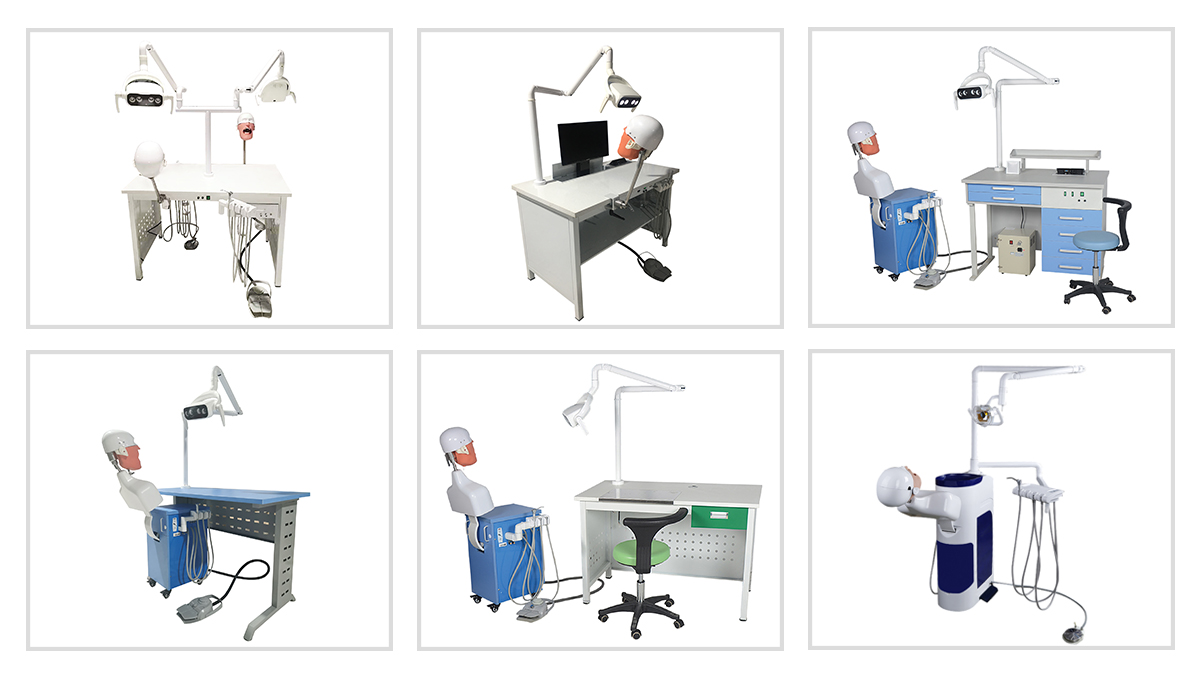
A teaching laboratory is measured in student positions, not cases per day. The equipment is bought in multiples, has to survive inexperienced handling, and is usually specified together with simulation units and phantom heads. For the teaching side of the room, see dental simulation units; for the production side — trimmers, vibrators, curing units, steam cleaners — the groups on this page apply as they do in a commercial laboratory, only in larger quantities.
Distributors buy a mix rather than a bench: fast-moving small units, a few demonstration machines, and consumables that repeat. Mixed orders are quoted together and packed per model, since furnaces and bench tools do not travel the same way. If you stock a range, ask for the model list with carton dimensions, so warehouse planning and import documentation can be done once instead of per shipment.
Dental laboratory equipment that cannot be kept running is expensive equipment. These are the items that wear, and the ones worth ordering with the machine rather than after it.
Flasks take the wear in denture processing: repeated heating, clamping and cleaning distort the halves and the fit between them. Crucibles in a casting machine are consumed by the melt. Both are ordered by size to match the unit, and both are worth shipping with the first order. Ask which flask size the injection or press unit accepts before buying a stock of them, since a flask that does not seat properly wastes the investment inside it.
Trimmers, lathes and polishers are only as good as what spins on them. Wheel diameter and bore, spindle size and the abrasive grade all have to match the unit. For the rotating instruments used at the bench, the bur range is listed separately under dental diamond burs, and the handpiece side under dental lab micromotors.
Dust collectors and steam cleaners have filters, seals and water paths that need attention on a schedule rather than after a fault. Spent filter bags, blocked nozzles and scale in a steam generator are the three most common reasons a bench unit underperforms. Confirm the filter type and the water quality the unit expects in the destination city, because hard water shortens the maintenance interval and is rarely mentioned at the quotation stage.
Whatever the group, a small spares kit avoids a stopped bench: heating elements and thermocouples for furnaces, sealing rings and nozzles for injection and steam units, drive belts and carbon brushes for rotating equipment, and lamp assemblies for curing units. Ask for the recommended spares list for the exact models in your order and we will price it with the machines rather than as a separate shipment later.


Quotations are issued on an EXW basis, so the freight is visible and can be arranged by your own forwarder or by ours. For buyers without a forwarder, we work with one we have shipped with for years and can arrange the movement to the destination port; the choice is yours and it does not change the equipment price.
Before the goods are packed you can ask for a video inspection, and after packing for photographs of the packed cartons and of the container being loaded. Buyers who cannot visit Tangshan use these records instead of a factory visit, and they settle most questions about condition on arrival without a claim.
Dental lab equipment carries a one year warranty. If a unit gives trouble inside that period, send photographs or a video of the fault and we replace it, which is faster than returning a machine across an ocean.
Documentation is prepared with the shipment. Tell us at quotation stage what your customs broker or health authority requires, since the list differs by country:
Six reasons buyers give for placing a second order, in their words rather than ours.
Casting, firing, injection, finishing, model work, cleaning, curing and bench tools sit in one catalogue, so a full laboratory can be quoted as a single order instead of eight separate purchases.
Tangshan UMG Medical Instrument Co., Ltd. manufactures dental instruments in Hebei, China. Questions about a model reach the people who build and pack it.
Customisation is available. Tell us what has to change — branding, packaging, voltage configuration or a model combination for one bench — and we confirm what is possible for that specific model.
The company holds an ISO 13485 quality management system certificate, and CE applies to the models in our CE-marked range. Free Sale Certificate and Registration Certificate of Medical Device are issued where an importer needs them.
Ask for a video inspection before packing, plus packing photographs and loading photographs. Buyers who cannot visit the factory use these records instead of a site visit.
Equipment carries a one year warranty. If a unit gives trouble, send photographs or a video of the fault and we replace it rather than asking you to ship it back first.
A quotation comes back the same day when the enquiry carries the details below. None of them is compulsory, but each one removes a round of questions, and two of them — voltage and destination — change the price rather than the paperwork.
| What to send | Why it changes the quotation | Example |
|---|---|---|
| Model number, or the group you are buying from | Fixes the exact machine and its current price | “UM-MC-107-1” or “a variable-speed polisher” |
| Quantity per model | Sets unit and carton pricing, and whether the order ships as one lot | “2 furnaces, 6 trimmers” |
| Voltage, phase and plug type at the destination | Decides the configuration built and the cable supplied | “220 V single phase, EU plug” |
| Destination country and port | Packing, freight basis and documents | “EXW” or “CIF Mombasa” |
| Bench or room information | Tells us which models physically fit the space | “3.2 m bench, no compressed air line” |
| Consumables to ship with the machines | Keeps the first production run from stopping for a part | “flasks, wheels, filters” |
| Certificates required at import | Documents are prepared together with the shipment | “CE, Free Sale Certificate” |
| Branding or packaging changes | Confirms what customisation is possible for that model | “our logo on the control panel” |
Requests can be sent by email, or through the form on the contact page. If your model list already exists as a spreadsheet, send it as it is — we will return the same list with prices and pack sizes filled in.
The minimum working set is a model trimmer, a vacuum mixer, a vibrator, a curing unit, a sandblaster and a steam cleaner, with a burnout furnace and a casting or milling route added once the laboratory produces its own frameworks. A clinic laboratory can start with five of these; a commercial dental lab usually needs the casting, firing and injection groups as well. Tell us the work you intend to take in and we will list the models that cover it.
Yes. One enquiry can carry casting, firing, finishing and bench models together, and they are quoted as a single order with one set of documents. Packing is arranged per model, because a furnace and a bench lamp do not travel the same way, and the carton list is itemised so the container can be planned before it is loaded.
There is no single figure for the whole range. MOQ depends on the model, on whether the order is standard or customised, and on the packing used. Send the model list and we confirm the minimum for each item rather than quoting one number that would not hold for half of them.
The company holds an ISO 13485 quality management system certificate, and CE applies to the models in our CE-marked range rather than to every item on this page. Tell us the models you intend to import and we confirm the certificate status of each one. Certificate of Free Sale and Registration Certificate of Medical Device are issued where the destination requires them.
OEM and ODM requests are accepted and customisation is available. The scope differs by model: branding on the unit or the carton, packaging changes, voltage configuration, or a model combination packed as one kit for a specific bench. Send the requirement and we confirm what is possible for the model you have chosen before the order is placed.
Quotations are EXW, so freight is separate and can be arranged by your forwarder or by ours. Equipment is packed per model in export cartons, with heavier units on pallets or in crates where the weight requires it. Before shipment you can request a video inspection, packing photographs and loading photographs, which is how most overseas buyers confirm an order without visiting the factory.
One year. If a unit develops a fault inside that period, send photographs or a video showing the problem and we replace it. This route exists because returning a machine across an ocean costs more than the part, and because a photograph of a failed component is usually enough to identify it.
Yes. Heating elements, thermocouples, sealing rings, nozzles, belts, brushes and lamp assemblies are available as spares for the models we list. Ask for the recommended spares list with the quotation, since ordering them with the machine avoids a second shipment later, and confirm the consumables you will reorder on a cycle so the packing can be planned once.
A teaching laboratory is specified by student positions rather than by cases per day, and the usual order is a multiple of each unit plus the simulation side of the room. Send the number of positions, the courses taught and the power available in the room, and we will propose a set with the quantities per station.
Send the model numbers or the group you are buying from, the quantity, the voltage at the destination and the port. We reply with prices, pack sizes and the certificate status for each model — one order, one set of documents.
Request a Wholesale Quote Download Specifications