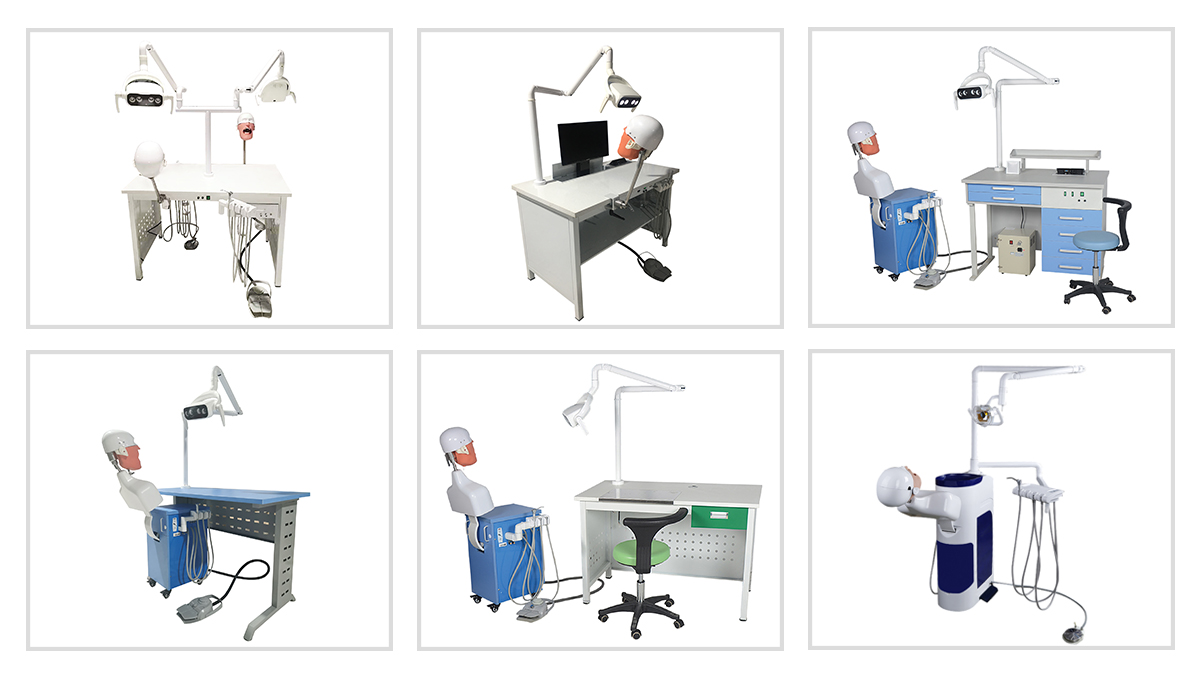

A dental simulation unit reproduces the working position of a patient so that students can practise before they work on one. The phantom head, the instrument hoses, the suction and the water supply are arranged as they are at a dental chair, and the height and tilt are adjusted the way a chair is adjusted. Most units are built from a metal frame with PVC and model components, which is what makes them survive a teaching room.
UMGROUP lists 18 dental simulation units on this page, from a bench-top head that fits an existing table to a two-way teaching system with a camera at the tutor station. They are grouped below into four tiers by how they are installed and how many students use them, so a school can start from the room rather than from the model name. Every unit links to its own page with photographs and the current configuration.
Choose the tier from the room and the class size. The full list of 18 units, with the specification of each, follows on this page.
For a school adding practice positions to rooms that already have benches, or a clinic that wants one station without rebuilding the room.
The main teaching configuration: the phantom head rises and falls under power, and the unit carries its own desk so a position can be installed in a normal room.
Where the budget is measured per student position rather than per unit, or where the course requires a tutor and a student to work on the same case.
For demonstration-based teaching: a camera at the tutor station, screens at the student stations, and connections for the classroom display.


The table lists every dental simulation unit on this page with the four facts that decide a purchase order: how many students work at it, how the phantom head moves, whether the unit carries its own desk, and which tier it belongs to. Configuration details beyond these four are on the product page of each model, and any of them can be confirmed with the quotation.
| Dental simulation unit model | Student positions | Head movement | Desk or bench | Tier |
|---|---|---|---|---|
| UMG-I Electric Simple Dental Simulation Practice System | Single | Electric | Supplied as a simple electric unit | 1 |
| UMG-III No Drawer Dental Simulation Practice System | Single | Same system as UMG-II | Clear work table, no drawer | 1 |
| UMG-IV L Dental Simulator | Single | Manual height adjustment | Installs on an existing table | 1 |
| UMG-IV Adjustable Phantom Head Dental Simulation Practice System | Single | Electric | With desk | 2 |
| UMG-IV Plus Dental Simulation Practice System | Single | Electric | Movable unit with desk | 2 |
| UMG-IVY Dental Simulator | Single | Electric | Movable unit with desk | 2 |
| UMG-B1 Dental Simulation Unit | Single | Electric rise and fall | With desk | 2 |
| UMG-VI Two Sets Of Memorial Position Dental Simulation Practice System | Single | Electric | With desk | 2 |
| UMG-VI Mini Dental Simulator | Single | Electric rise and fall | Compact | 2 |
| UMG-II Double Draw Dental Simulation Practice System | Single | Computer-controlled tilt | Double drawer | 3 |
| UMG-II L Dental Simulation Unit | Single | Computer-controlled tilt | With drawer | 3 |
| UMG-II-PLUS Pneumatic System Dental Simulation Practice System | Single | Pneumatic | With commodity shelf | 3 |
| UMG-VIII Dental Simulation Unit | Single | Electric | With desk | 3 |
| UMG-VIII PLUS Dual-Person Dental Simulation Unit with Manikin | Dual | Electric | Dual-person unit | 3 |
| UMG-IX 2 Student Positions Dental Simulation Practice System | Two positions | Electric | Two-student configuration | 3 |
| UMG-VI-plus New Style Dental Simulation Practice System | Single | Electric | With desk | 4 |
| UMG-VII Dental Simulation System | Single | Electric | With desk | 4 |
| Stamotology Teaching System | Classroom | Two-way system | Teacher and student stations | 4 |
Tier 1 units install on a bench or in a simple configuration; tier 2 units carry a desk and move the head under power; tier 3 covers two-student and classroom configurations; tier 4 adds imaging and multimedia for demonstration teaching. A model appearing in one tier does not exclude it from another use — tell us the room and the class size and we will say which units fit.
A dental simulation unit is not a single item, which is why two quotations for the same model can differ by a wide margin. The list below is the working configuration of a complete teaching position. Use it as a checking sheet against any quotation, ours or another supplier's, because the items that are quietly left out are usually the suction, the water system and the stool.
Not every tier carries every item as standard. The units in tier 1 are simpler by design and a school that needs suction and a water system should start from tier 2. Ask for the configuration list of the exact model when comparing prices, and ask whether the handpiece tubes, the syringe and the suction are included or priced separately.
Six questions decide the purchase, and they are listed in the order they usually cut the list down. The first two are about the room; the rest are about the course.
Count teaching positions, not students. A class of thirty that rotates through a room of fifteen positions needs fifteen, and a dual-person unit counts as two only if both students can work at the same time without moving the head. State the number of positions, the number of intakes per year and whether the room is also used for examinations, because an examination room usually needs one position per candidate.
Measure the room before choosing the unit: a unit with a desk needs floor area, not bench area, and a row of them needs circulation space behind the operator stools. Confirm the power available at each position and whether a compressed air line reaches the room. The pneumatic model on this page needs an air supply; the electric units do not. A room that cannot be re-wired is a constraint on the tier, not on the brand.
Confirm what the phantom head arrives with: the cranium, the jaws, the tooth model and the face mask. The tooth model is the part that wears out first in a teaching room, so ask how replacement teeth and replacement jaws are ordered and whether they are stocked. A unit that accepts standard model teeth is easier to keep running than one that needs a proprietary set.
Teaching positions need weak suction, a water supply and two handpiece tubes. Confirm whether these are part of the unit or site-provided, and how the water is supplied — a purification system on the unit, or a central supply in the building. On a pneumatic unit, the suction and air gun are configuration choices rather than fixed parts, which changes both the price and the installation work.
The position of the head is set by the foot switch on most units, and the memory positions matter in a teaching room: a student who can return the head to a stored position between exercises learns faster than one who re-adjusts it each time. Confirm how many memory positions the model holds, whether the lamp is on the unit, and whether the switch controls the head only or the handpiece as well.
A teaching room runs the equipment harder than a clinic does. Ask what wears: model teeth, face masks, handpiece tubes, the syringe, the foot switch and, on pneumatic units, the seals. Ask for the recommended spares list with the quotation and confirm that replacement parts are available for the model rather than the range in general. A position that is out of service in the middle of a term costs more than the part.
Work through this list before the enquiry, not after the quotation. Each line is something the supplier has to know to answer accurately, and something the school has to decide internally anyway.
| Item to settle | What to establish | Who decides |
|---|---|---|
| Number of positions | Teaching positions needed now, and the number the room could take if the course grows | Head of school |
| Room layout | Floor plan with position spacing, circulation behind the stools and the tutor station | Facilities |
| Power | Voltage, number of outlets per position, whether a dedicated circuit is available | Facilities |
| Air supply | Whether a compressed air line reaches the room, and the pressure available | Facilities |
| Water and drainage | Supply for the handpiece and syringe, and drainage for the suction | Facilities |
| Phantom head configuration | Cranium, jaws, tooth model and face mask included or extra | Course lead |
| Imaging | Whether the tutor station needs a camera and screens, and how the signal reaches the classroom | Course lead |
| Delivery and installation | Access to the room, floor loading, and who assembles and commissions the units | Facilities and supplier |
| Spares and consumables | Model teeth, face masks, tubes and seals — the first order and the reorder cycle | Course lead |
| Documents and budget | Certificates required at import, tender documents, and the delivery date the term requires | Purchasing |
Quotations are issued on an EXW basis, so freight stays visible and can be arranged by your own forwarder or by one we have shipped with for years. A teaching room order is usually several units on one booking, and the carton list is itemised per position so the room can be planned before the container is unpacked.
Before the goods are packed you can ask for a video inspection; after packing, for photographs of the cartons and of the container being loaded. Buyers who cannot visit Tangshan use these records instead of a factory visit, and they settle most questions about condition on arrival without a claim.
Dental simulation units carry a one year warranty. If a unit gives trouble inside that period, send photographs or a video of the fault and we replace it, which is faster and cheaper than returning a unit across an ocean.
Documentation is prepared with the shipment. Tell us at quotation stage what your customs broker or health authority requires, since the list differs by country:
Six points that come back in conversations with schools and distributors after the first order.
A bench-top head and a two-way teaching system come from the same supplier, so a school can fit one room and extend another without changing brand.
Metal frame with PVC and model components, chosen for student handling rather than for clinic duty.
A room without an air line can still be fitted; a room that has one can use the pneumatic unit with suction and air gun.
Where the cost is counted per student position, a two-student unit changes the arithmetic without changing the course.
Camera, screens and HDMI or VGA connections for demonstration teaching, on the units specified for it.
Video inspection, packing photographs and loading photographs on request, which is how overseas schools sign off an order without visiting.
A quotation for a teaching room comes back the same day when the enquiry carries the details below. None is compulsory, but each one removes a round of questions, and two of them — the number of positions and the destination — change the price rather than the paperwork.
| What to send | Why it changes the quotation | Example |
|---|---|---|
| Number of student positions | Decides the quantity and whether dual-person units are cheaper per position | 15 positions, one intake a year |
| Preferred model or tier | Sets the configuration and the packing | Tier 2, electric with desk |
| Room plan and power | Confirms the tier and the installation work | 220 V, 8 outlets, no air line |
| Phantom head items required | Cranium, jaws, tooth model and mask may be extra | Two spare tooth models per position |
| Destination country and port | Freight, documents and plug type follow the destination | Jebel Ali, United Arab Emirates |
| Certificates and tender documents | Issued per order, and some tenders need them before award | CE documentation plus Free Sale |
The control panel moves the shoulder body up and down and tilts the phantom head, reproducing the position of a patient in a chair. The handpiece tubes, the three-way syringe and the suction are arranged at the head so the student works in the same posture as at a dental chair. On the electric units the movement is powered; on the pneumatic unit the positioning is air-assisted.
The manikin is the patient model — the head, cranium, jaws and face mask. The simulation unit is the equipment that holds and positions it, with the instruments, suction and water. Most schools buy the unit with a manikin fitted; a school that already owns manikins should confirm that the unit accepts them.
One position per student working at the same time, not per student enrolled. A class of thirty rotating through a room in two groups needs fifteen positions, unless the course requires each student to hold a position for the whole session. Dual-person units count as two positions only where both students can work without moving the head.
Only for the pneumatic model. The electric units run from the power supply, and the pneumatic unit needs a compressed air line for the positioning system, with suction and an air gun as configuration choices. A room with no air line should be planned around the electric tiers.
Yes, and that is what the tier 1 units are for: a bench-top configuration and a unit that installs on an existing table, both of which avoid rebuilding the room. What has to be checked first is the power outlets per position and the space behind the operator stools, not the floor area alone.
The dual-person unit and the two-position unit on this page, both in tier 3, and the two-way teaching system in tier 4 where a tutor station and a student station work together. Confirm the arrangement you intend — side by side, or tutor and student — because the two configurations are different products.
There is no single figure across the range. MOQ depends on the model, on whether the order is standard or customised, and on the packing. Send the model list and the number of positions and we confirm the minimum for each item rather than quoting one number that would not hold for half of them.
OEM and ODM requests are accepted and customisation is available. The scope differs by model: branding on the unit or the carton, packaging changes, voltage configuration, or a kit built for a specific course. Send the requirement and we confirm what is possible for the model you have chosen before the order is placed.
One year. If a unit develops a fault inside that period, send photographs or a video showing the problem and we replace it. Consumable parts that wear in normal teaching use — model teeth, face masks, handpiece tubes — are supplied as spares rather than covered as faults.
Send the number of student positions, the room plan, the power and air available and the destination port. We reply with the recommended tier, prices, pack sizes and the certificate status for each model.
Request a Wholesale Quote Download Specifications