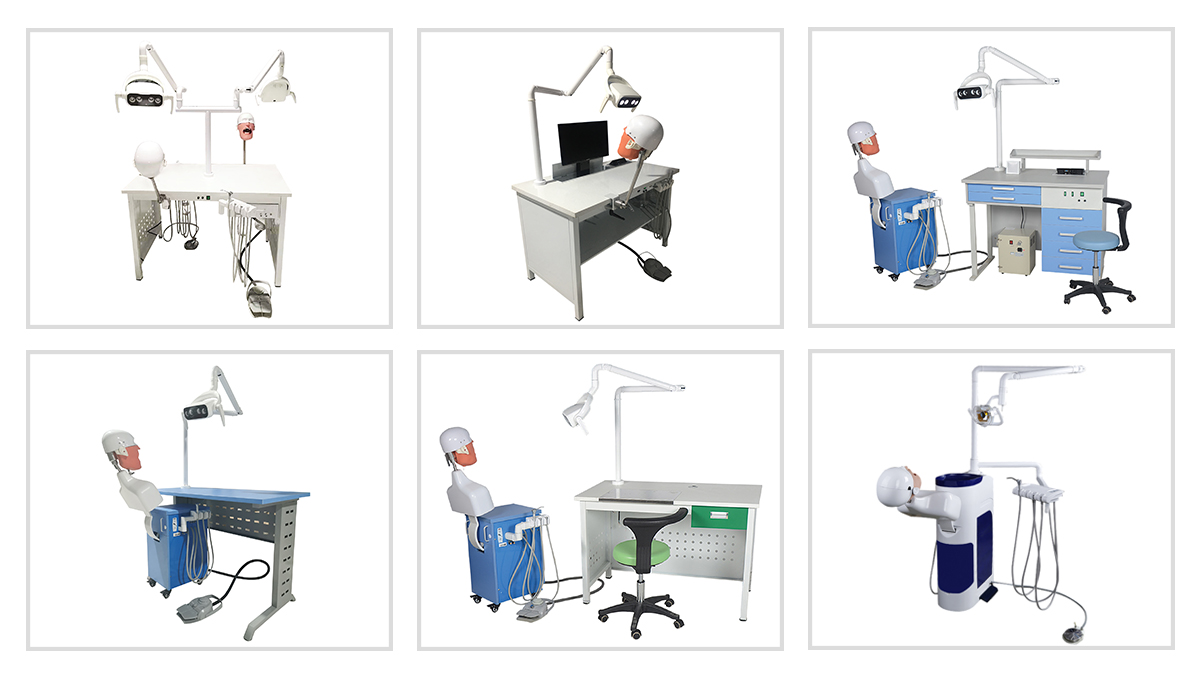
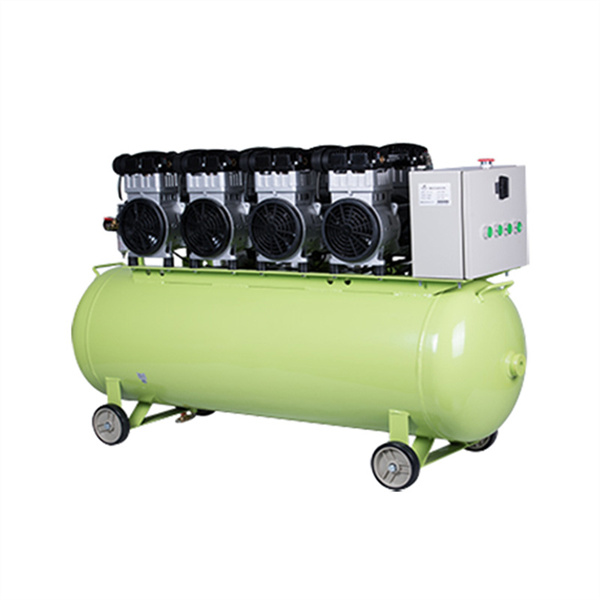
UMG builds oil-free dental air compressors in Tangshan, China, for dental clinics, dental laboratories and dental school simulation rooms. The range is organised by the number of working positions rather than by horsepower: seven models are numbered by the number of simulators they carry, from 10 to 50, two are numbered by the number of dental chairs, at 20 and 30, and three series — HV, UM-J and UM-E — group the same oil-free piston technology by frame size.
Every model in the range is oil-free. The piston runs in a nano-coated cylinder liner with no lubricating oil in the crankcase, so nothing in the air path can carry oil mist into a handpiece, a three-way syringe or a sterilizer. Receivers run from 160 L on the smallest simulator unit to 1,000 L on the largest, and the chair models are delivered as a pump unit plus a separate 300 L receiver, so the compressor can stand in a service room while the tank sits closer to the chairs.
The table below lists the models whose figures are published on their own product pages. Air flow is given as displacement, which is the figure to compare when two machines are quoted at the same 8 bar maximum pressure.
| Model | Sized for | Receiver | Power | Air flow | Noise |
| UM-163 | 10 simulators | 160 L | 4,800 W | 1,000 L/min | 55 dB |
| UM-164 | 16 simulators | 200 L | 4,800 W | 960 L/min | 68 dB |
| UM-165 | 20 simulators | 240 L | 8,000 W | 1,650 L/min | 57 dB |
| UM-166 | 25 simulators | 300 L | 9,600 W | 1,800 L/min | 62 dB |
| UM-168 | 32 simulators | 600 L | on request | on request | on request |
| UM-1610 | 40 simulators | 600 L | on request | on request | on request |
| UM-1612 | 50 simulators | 1,000 L | on request | on request | on request |
| UM-1920 | 20 dental chairs | 300 L | 8,400 W | 1,050 L/min | 85–88 dB |
| UM-1930 | 30 dental chairs | 300 L | 12,000 W | 1,680 L/min | 85–88 dB |
Selected models from each family are listed. Where a figure reads on request, that value is published only in the model datasheet and is supplied with the quotation. All models are rated at a maximum pressure of 8 bar. UM-1920 and UM-1930 deliver their flow from a 300 L receiver supplied as a separate tank, so the compressor can be sited away from the treatment rooms — which is also why both read 85–88 dB at source. UM-1930 uses eight 1,500 W motors.
The model number is the selection key, and it answers a different question in each family. That difference matters in a quote, because a laboratory counts simulators and a clinic counts chairs.
| UM-163 → UM-1612 Numbered in simulators | For dental schools and prosthetic laboratories, where 10 to 50 phantom heads or simulators run from one machine. The digits after UM-16 give the number of simulators: UM-166 carries 25, UM-1610 carries 40. |
| UM-1920 / UM-1930 Numbered in dental chairs | For clinics and polyclinics running 20 or 30 dental units. These are the models to quote when the buyer counts chairs, and the ones that answer the search for a compressor for dental chair installations. |
| HV / UM-J / UM-E Series, not single models | Three series on different frames — HV runs from HV-400 to HV-2400, UM-J is built on a large-flow piston pump, and UM-E is the compact oilless series. Choose a series first when the frame size or the receiver shape has to fit an existing plant room. |
A dental laboratory buying one machine for a teaching bench usually starts at UM-163 or UM-164 and moves up only when the number of students working at the same time increases. A clinic with chairs should start at UM-1920, because the duty cycle of twenty chairs is not the same as twenty simulators used in a two-hour class — the chairs draw air all day, from three-way syringes, turbines and the chair's own pneumatic controls.
Where the compressor is part of a fit-out, it is normally specified with the dental chairs and the dental suction unit, since all three connect to the same service room and the same drain. For a laboratory rather than a clinic, the equivalent starting point is the dental laboratory equipment range.




An intraoral X-ray is a small machine with a narrow job: it exposes one tooth or one group of teeth, at a short focal distance, in a fraction of a second. Everything that varies between the models below is a consequence of that job — how the tube head is held, how the exposure is timed, and whether the image arrives on film or on a screen.
SPECIFICATIONS IN COMPARISON
The four models below have published figures. All of them run a tube at 60 kV, which is the standard for intraoral work; what changes is the tube current, the exposure range and the source of power.
| Model | Form | Voltage | Current | Exposure | Power source |
| UM-680 | Handheld | 60 kV | 2 mA | 0.1–2.0 s | 14.8 V / 2,500 mAh |
| X-12D | Handheld, 1.8 kg | 60 kV | 0.28 mA | 0.3–1.5 s | 24 V / 5,000 mAh |
| BLX-5 | Portable, mains | 60 kV | 0.1 mA | 1–9 s | AC 220 V, 60 W |
| UM-120RC | Chair-side, touch screen | 60 kV | 2 mA | 0.01–2 s | Inverter above 100 kHz |
On radiation, these units are quoted with a published leakage figure rather than a slogan: 0.25 mGy/h or lower on the UM-680 and the X-12D, and 20 μGy/h or lower on the BLX-5, which states compliance with IEC 60601-1-3. Ask for the leakage figure in writing on any model you compare — it is the number a hospital physicist will check. The GH series (standards, gun and square body), UM-1S and UM-10S are quoted on request with their own figures. On the UM-120RC the ripple ratio is quoted below 1% and the exposure is set on the touch panel in hundredths of a second, which matters when a paediatric exposure is being shortened rather than a molar exposure lengthened.
A handheld unit and a chair-side unit are not competing for the same buyer. The handheld machine is chosen by a clinic that has to move between treatment rooms, by a surgeon working in a second location, or by a practice that cannot run a fixed supply to the chair. The chair-side machine is chosen where the room is fixed and the exposure is set at the panel rather than at the cone — and where a higher tube current shortens the exposure.
SENSORS AND RETROFIT
A digital sensor replaces the film packet and the processing that follows it. The sensor sits in the mouth in the same position the film would take, the existing tube head exposes it, and the image is transferred by USB to the PC at the chair. Three sensor families are stocked: UM2121/UM2530, UMG-YR0001/YR0002 and HDR500/HDR600.
This is the route with the smallest change to the practice. Nothing in the treatment room is rebuilt, no control room is added, and the exposure settings on the existing unit stay where they are — what changes is what happens after the exposure. It is also the route that most often decides whether a clinic keeps a working film unit instead of replacing it, because the head is usually the part that is still healthy.
The sensor and the unit have to be matched: the active area has to cover the teeth being imaged, the cable has to reach the PC without crossing the working field, and the imaging software has to accept the driver. Send us the X-ray unit you are keeping and the PC operating system, and we will confirm the sensor family before the order rather than after.
PERIAPICAL WORK
A periapical exposure covers the whole length of a tooth including the apex, and it is the exposure most intraoral units in this range are bought for — root canal work, apical pathology, a single implant site. Two figures decide how easily a unit does it. The first is the field: on the UM-680 the line-field limiting diameter is 58 mm, which frames a periapical view without the cone having to be repositioned between the mesial and distal surfaces. The second is the focal distance: 100 mm from focal spot to skin on the handheld models, which is the distance the cone has to be held at, and the reason a handheld unit is held with a steady grip rather than braced against the wall.
Focal spot size is the third number worth comparing, and it is 1.5 mm on the X-12D. A smaller focal spot sharpens the image at the same exposure; a larger spot tolerates a shorter exposure in a restless patient, so neither is simply better. Ask for this figure on any model you compare, because it is not always printed on the sheet.
Wholesale buyers ordering for a distributor network usually take the periapical units in mixed cartons with sensors, because a clinic buying one usually buys the other. Mixed orders are quoted as one shipment.
BEFORE THE ORDER
QUESTIONS WE ARE ASKED
Buy the portable if the unit has to move — between rooms, between floors, or to a second site — or if the room cannot take a fixed installation. Buy the chair-side unit if the room is permanent and the exposure is set at the chair. The portable saves installation; the chair-side saves handling time in a busy room.
Usually yes, provided the unit's exposure can be set low enough for a sensor and the sensor's active area suits the teeth being imaged. Send the make and model of the existing unit, the exposure range and the PC operating system, and we will confirm the sensor family that fits.
The units will expose film, and the BLX-5 is specified for daylight film processing, so no darkroom is needed. Most clinics now pair the unit with a sensor instead, which removes the processing step entirely.
All the intraoral units on this page take periapical exposures; what differs is the field size and the focal distance. The UM-680's 58 mm field and 100 mm focal distance are the figures to compare against the way your clinicians position the cone.
Yes. Units and sensors are quoted for single-clinic orders and for distributor orders, and a mixed order of units, sensors and mounting accessories ships as one consignment. Tell us the market and the volumes and we will quote accordingly.
Send the exposures you need to take, the number of rooms and whether you are keeping an existing X-ray head, and we will recommend the route and the model. Request a quotation for dental X-ray equipment.