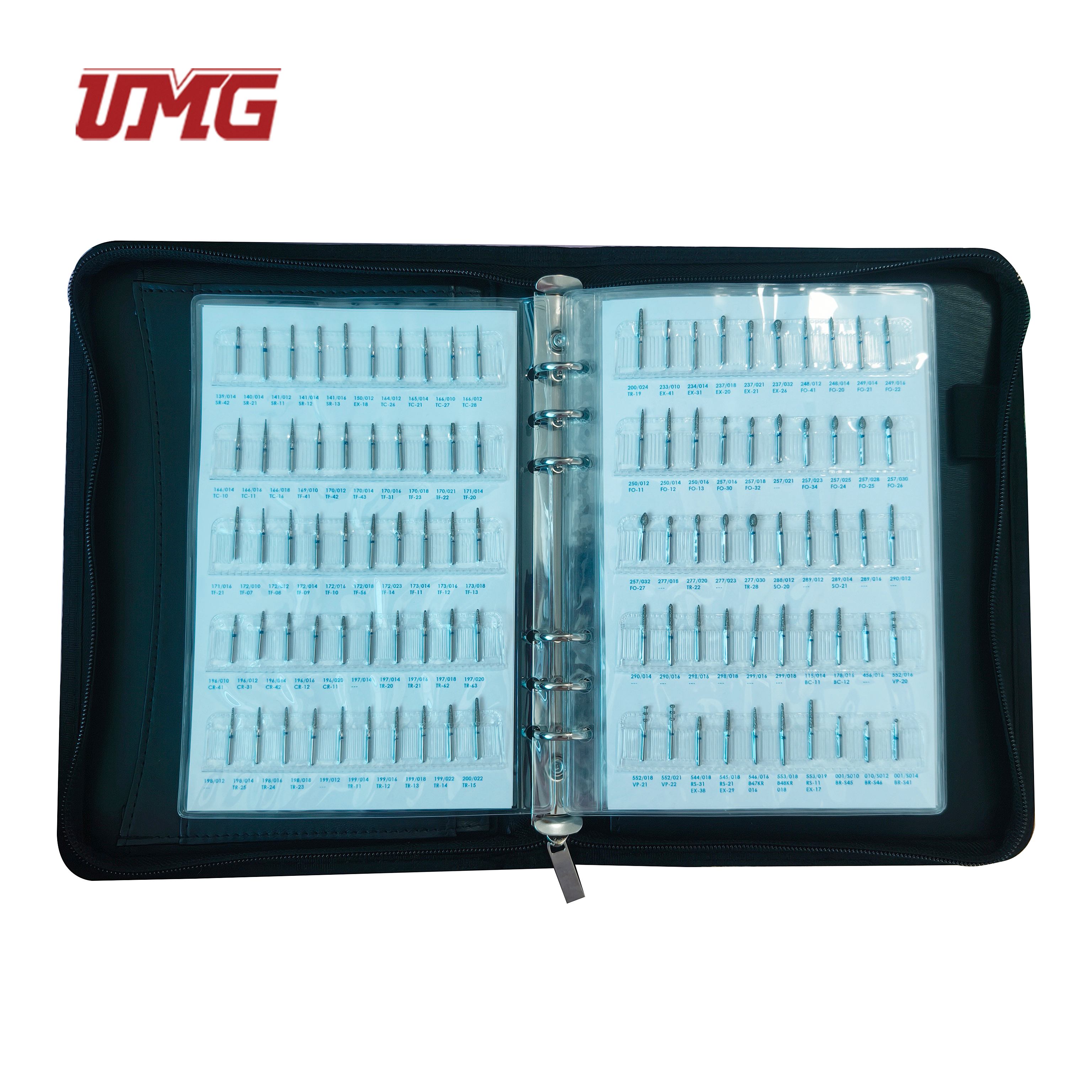

This page covers the wholesale side of the dental diamond bur range: what has to be settled before an order, what arrives in the carton, and what we need from you to quote an item code instead of a description. The specification panels, the intended-use limits and the eight handling steps are set out further down.
An order is built item by item. A range is a list of codes, each carrying its own head shape, head diameter, grit grade, shank type and pack quantity — so a quotation is only as precise as those fields, and a reorder is only as fast as the code on the pack.
Further down this page: the four fields to settle before an order, the intended-use limits, the eight handling steps, and the pack quantity and MOQ terms.
Ask for the Grit Chart


A dental diamond bur is a small purchase with a long list of variables: the grit grade, the head shape, the shank diameter and the material the bur is meant to cut. Two burs that look identical in a photograph can differ in every one of them. The four dental diamond bur specification panels below are the fields to settle before a wholesale order, and they are also the four fields our quotation sheet answers for each item.
UMG dental diamond burs follow the ISO colour and grit identification, so the band on the shank carries the grade. The colour chart ships with the quotation sheet rather than being reproduced from memory here: ask for the chart for the range you are ordering and match it against the work the bur has to do — coarse for bulk reduction, fine for finishing and margins.
Head shape decides access: round for cavities and undercuts, tapered and flame shapes for crown preparation, pointed shapes for narrow embrasures, wheel shapes for slicing. Head diameter and working length are quoted per item, and both matter on a posterior tooth where a larger head will not reach the margin without cutting the adjacent surface.
The shank is stainless steel, and it has to match the handpiece chuck rather than the bur head. Confirm the shank type used by your handpiece system and the diameter before ordering in quantity, because a bur that does not seat fully will run off centre however good the diamond coating is. Shank type is quoted per item and mixed shank types can be packed in one order.
Our diamond burs are intended for finishing, carving and smoothing the fine parts of dental work pieces: metal crowns and frameworks, the inner surface of metal crowns, porcelain teeth, resin teeth and resin bases. They are not intended for the outer face of a crown, where the surface finish is the restoration itself. State the material mix you work with and we confirm the grade per material.
The two columns below summarise how a dental diamond bur in this range is meant to be used, and they come from the instructions supplied with the order rather than from general practice. Where a bur is used outside the intended list, the finish is the buyer's decision rather than a specification we support.
For the burs used in the laboratory rather than at the chair, the machines that drive them are listed under dental lab micromotors, and the wider bench range under dental lab equipment.


On a dental diamond bur the working part is built up by multi-layer plating of diamond particles rather than a single coating. The practical effect is that when the outermost particles wear, fresh sharp particles are exposed underneath and the instrument keeps cutting instead of polishing the surface with a dull layer. That is the difference buyers notice on the second and third use, and it is the reason a cheaper single-coat bur costs more per procedure than its price suggests.
The shank is stainless steel, chosen so that it does not bend or rust in the handpiece. Inspection is carried out across the production run with laser measurement rather than by sampling, which is what keeps the shank diameter consistent enough to seat properly in a chuck.
Range composition differs by market, so the shapes below are the ones to specify by name rather than to assume: round, inverted cone, tapered fissure, flame, pointed, wheel and cylinder with a flat or rounded end. Ask for the shape list with the item codes before ordering a mixed set, since a kit built for crown preparation contains a different mix from one built for cavity work.
Shank type is the first question on a wholesale enquiry, because the same bur head is offered on more than one shank system and only one of them fits the handpiece in use. Confirm three things together — the shank type, the diameter and the handpiece model — and the order will fit on arrival. Mixed shank types can be packed in one carton, which is useful for a distributor serving both chair-side and laboratory customers.
These steps are the handling instructions supplied with every dental diamond bur in the range. They are worth passing to the clinician or technician who will use the burs, because most complaints about diamond instruments trace back to one of the first three.
Insert the shank into the handpiece following the handpiece manufacturer's instruction, to the full insertion length.
Run the instrument before use to check for off-centre rotation. If it runs out of true, remove it from service.
Always use the spray. A plentiful water supply maintains performance and prevents loading.
Keep pressure at 20–50 p for instruments up to Ø023. Excessive load shortens the life of the coating.
Do not exceed the maximum permissible rpm of the individual instrument; breakage at overspeed is a safety risk.
Avoid levering, tilting, twisting and jamming, and do not work with a pulling motion.
Wear safety glasses and a face mask. The instruction sheet states this as a requirement, not a recommendation.
Do not use a high pressure steam sterilizer above 200 °C including the drying stage. Dispose of used burs as medical waste.
The limits below are the ones stated for the dental diamond bur range. Anything outside them is a question for us rather than an assumption to make at the bench, and the answer depends on the model.
| Item | What the instruction states | What to confirm before ordering |
|---|---|---|
| Sterilization | Do not use a high pressure steam sterilizer that heats above 200 °C, including the drying process | The cycle your clinic or laboratory actually runs, including drying temperature |
| Cooling | A plentiful water supply is required during use | Whether your handpiece delivers spray through the bur or externally |
| Load | Pressure of 20–50 p for instruments with a diameter up to Ø023; avoid levering and tilting | The maximum rpm and load for the exact item, from its chart entry |
| Inspection | Check for off-centre rotation before every use; withdraw a bent instrument | Whether your protocol records this check, since it is a patient safety step |
| Disposal | Treat used burs as medical waste | The waste stream required in your country |
| Certification | Certificate status is confirmed per model and per destination; CE applies to the models inside our CE-marked range | The exact certificate list your importer needs, before the order is placed |
We do not publish a sterilization temperature range beyond the limit above, a re-use count, or a service life figure for a diamond bur, because none of them is a single number across the range. Ask for the instruction sheet of the model you are ordering and it will be sent with the quotation.
A dental diamond bur order is packed by item, and the pack quantity is set per item rather than per order. That is why a mixed order of ten items arrives as ten labelled packs rather than one mixed box, and why the carton list is itemised.
Pack quantity is stated with the quotation for each item, because it differs between shapes and between shank types. Two consequences follow for the buyer: the unit price is only comparable against the same pack quantity, and the shelf label should carry the pack count rather than the item count. A distributor building a stock list should ask for the item list with pack quantities in one file, so the shelf plan and the reorder point can be set once instead of per shipment.
Minimum order quantity for a dental diamond bur varies by model and packaging. Contact us to confirm the minimum order quantity for your selected specifications — a single figure quoted across a whole range would not hold for the items a clinic actually reorders, and would mislead the buyer on the first order. Where a mixed order carries several items, the minimum is applied per item rather than to the carton as a whole.
Reordering is by item code, and the code should be recorded from the pack rather than from the quotation, since a range revision can change the packaging while the code stays the same. If the code is lost, a photograph of the bur beside a ruler is usually enough to identify the shape and the rough size, and the shank type narrows it further. Keeping one used bur from each item as a sample is the cheapest reordering system there is.
A dental diamond bur quotation is only as accurate as the specification behind it. These six details remove the round of questions, and two of them — shank type and grit — decide whether the item can be used at all.
| What to send | Why it changes the quotation | Example |
|---|---|---|
| Shank type and diameter | The same head is offered on more than one shank system | FG shank, standard length |
| Head shape and size | Decides the item code and the pack quantity | Round, Ø012, for cavity work |
| Grit grade | Coarse and fine are different items, not different prices for one item | Coarse for bulk reduction, fine for margins |
| Material to be cut | Metal, porcelain and resin need different grades | Metal framework plus resin base |
| Quantity per item | Pack quantity is set per item; MOQ varies by model | 20 packs of the round 012 |
| Destination country | Freight, documents and import requirements follow it | Hamburg, Germany |
A photograph of the dental diamond bur you are replacing, laid beside a ruler, is often faster than a description. Send it with the quantity and we will identify the closest current item and confirm the grit.
From three figures: the head shape, the head diameter and the working length. The shape narrows the list, the diameter decides access, and the length decides whether the margin can be reached without the shank fouling the adjacent tooth. If the old bur is still in the drawer, photograph it beside a ruler and send it — the shape and rough diameter can be read from the photograph, and the shank type from the end.
The shank type, the shank diameter and the handpiece model, together. A dental diamond bur that does not insert to its full length will run off centre, and the diamond coating cannot compensate for that. Mixed shank types can be packed in one order, so a distributor does not need separate shipments for the two systems.
By the ISO colour identification and by the work the bur has to do, not by a number alone. Coarse grades remove material quickly and leave a rougher surface; fine grades finish and refine. Ask for the colour chart for the range you are ordering, since the chart is the reference that matches colour to grade for our items.
Do not use a high pressure steam sterilizer that heats above 200 °C including the drying stage, and treat used burs as medical waste. Beyond that limit the instruction sheet for the model applies; the exact cycle depends on the equipment in your clinic or laboratory, which is why the field is confirmed per order rather than published as one number.
MOQ varies by model and packaging. Contact us to confirm the minimum order quantity for your selected specifications. A single figure across the range would not hold for the items that repeat most, so we quote per item and state the pack quantity with it.
OEM and ODM requests are accepted and customisation is available. The scope differs by item: printing on the pack, a labelled kit built to your mix, or a range selected for your market. Send the requirement with the item list and we confirm what is possible before the order is placed.
By item, with the pack quantity set per item and the carton list itemised. Quotations are EXW, so freight is separate and can be arranged by your forwarder or by ours. Before shipment you can request packing photographs and loading photographs, which is how most overseas buyers confirm a small order without visiting the factory.
Send the shank type, head shape, grit and quantity per item, with the destination port. We reply with item codes, pack quantities, prices and the certificate status for each dental diamond bur on the list.
Request a Wholesale Quote Download the Item List