
UMG is a dental lab workstation manufacturer in Tangshan, China, building the technician benches used in dental laboratories, prosthetic laboratories and dental school training rooms. The range covers ten models, from a 1.0 m single-technician bench up to a 2.16 m two-station bench, each supplied with its own built-in dust extraction unit or prepared for connection to a central dust collection system. The three-technician bench measures 2.0 m across.
All ten models are 60 cm deep, so different benches still line up along the same wall, and the JT and T-series benches adjust between 80 cm and 85 cm in working height. Benches join end to end without a visible gap, so a second station can be added to an existing row later, and the wiring and suction hoses run inside the bench body instead of along the floor.
Bench length is the first decision, because it sets how many technicians can work side by side and how much bench-top equipment each station can hold. The table below lists every model in the current range by length and by the number of working positions.
| Model | Bench length | Technicians | Configuration |
| JT-52 | 1.0 m | 1 | Compact single bench for a small laboratory |
| JT-53 | 1.2 m | 1 | Standard single-technician bench |
| T-4 | 1.2 m | 1 | Knee-control micromotor, 2 sockets plus Cat 6 data |
| T-5(B) | 1.2 m | 1 | Stainless-steel working platform, four drawers |
| JT-54 | 1.4 m | 1 | Longer working surface for a single technician |
| JT-55 | 1.6 m | 2 | Two stations on one shared frame |
| JT-56 | 1.8 m | 2 | Two stations with a wider working surface |
| TT-2 | 1.8 m | 2 | Two stations, metal shelf, two lamps and two air guns |
| TT-3 | 2.0 m | 3 | Three stations, three dust collectors |
| TT-4 | 2.16 m | 2 | Two stations, two dust collectors, four sockets plus Cat 6 |
Bench lengths are nominal and measured on the bench body. The assembled bench adds end panels, so check the overall footprint against your room plan before ordering a two- or three-technician model.
One technician working with a handpiece and a micromotor is normally served by 1.0–1.2 m of bench. Stepping up to 1.4 m gives room for a second working area, a model trimmer or an articulator at the same station without moving the burs and instruments aside. Two technicians share a 1.6–1.8 m bench, which works out more economical per person than two single benches, and the three-technician model measures 2.0 m across — the usual choice for a teaching bench where an instructor works in front of several students.
Where a whole room is being fitted out, the benches are usually specified together with the dental lab micromotor and the dust extraction, because the micromotor is mounted through the bench top and the dust inlet has to sit beside it. The full laboratory range, including suction units, workbenches and finishing equipment, is listed under dental laboratory equipment.


A dental lab workstation is more than a table with drawers under it. The bench carries the electrical circuit, the suction line and the dust collection for one technician, and it has to hold the micromotor, the model and the instruments at a height that stays comfortable through a full shift. That is why the UMG bench is built as one unit, rather than a desk with a dust extractor bolted underneath it.
The frame is built from cold-rolled steel sections, die-cast aluminium alloy and aluminium profile, under a table top of high-density fireproof board. A hidden layer between the table top and the frame carries the wiring and the suction hoses, so the working surface stays clear and the bench can be wiped down without moving cables out of the way.
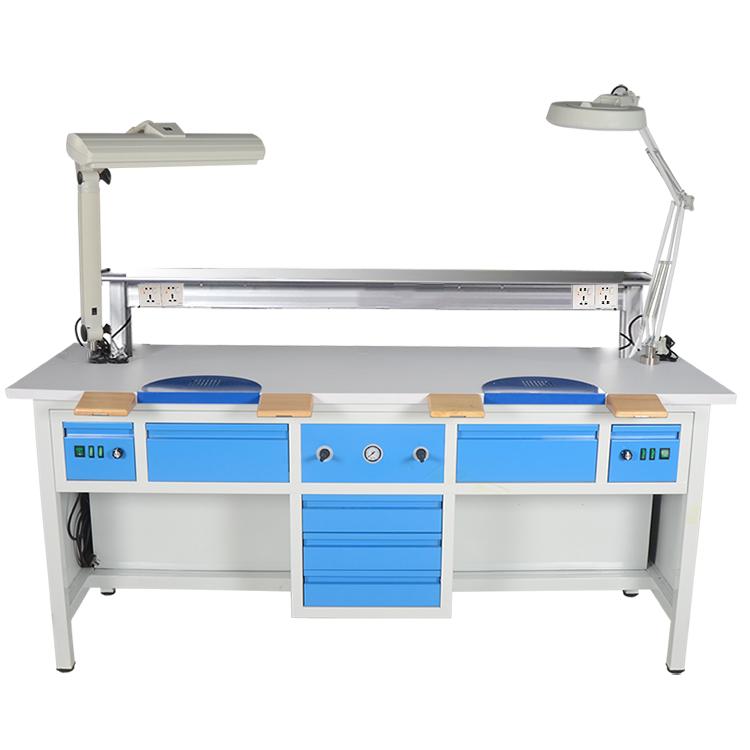
Each bench is supplied as a working station rather than a bare frame. The standard arrangement is:

Single-technician bench with the standard components called out
Every bench can be ordered in one of two dust configurations. With a built-in unit, each technician has a dust collector inside the bench and the suction starts and stops at that station. With a central system, the dust is collected by one plant elsewhere in the building and each bench is prepared for connection to that ducting.
Built-in units suit a laboratory with one to three benches, or a room where the benches may be rearranged later. A central system suits a fixed layout with four or more stations: it takes the noise and the dust bag out of the working area, and there is one filter to service instead of one per technician. Tell us which route you plan to take at the quotation stage, because the rear panel of the bench is prepared differently for the two.
| Bench depth | 60 cm |
| Working height | 80–85 cm, adjustable |
| Bench lengths | 1.0 / 1.2 / 1.4 / 1.6 / 1.8 / 2.0 / 2.16 m |
| Supply voltage | 220 V / 50 Hz or 110 V / 60 Hz |
| Dust unit power | 500 W |
| Air flow | 175 m³/h |
| Maximum vacuum | −16 kPa |
| Noise level | below 65 dB(A) |
| Dust collector service life | 800–1,000 hours |
Figures taken from the JT-54 data sheet. The TT-2, TT-3 and TT-4 use one dust collector per station — three collectors on the three-technician bench. Confirm the rating for the model you select.


The single-station dust collector is rated below 65 dB(A). Sound-absorbing cotton inside the housing brings the collector life to 800–1,000 hours of operation before the unit is replaced, and the digital window on the control box shows the hours accumulated, so servicing follows the meter rather than the calendar.
The table top decides how the bench copes with plaster, wax, monomer and bur dust, and it is the part of the bench that is hardest to change later. Five surfaces are available across the range:


Where monomer, plaster and steam are in constant use at the same station, stainless steel or granite is the safer choice. Fireproof board is adequate for a bench used mainly for finishing and polishing, and it is the top most laboratories order. Oak is specified for hand work and for rooms where the bench is part of the fit-out.
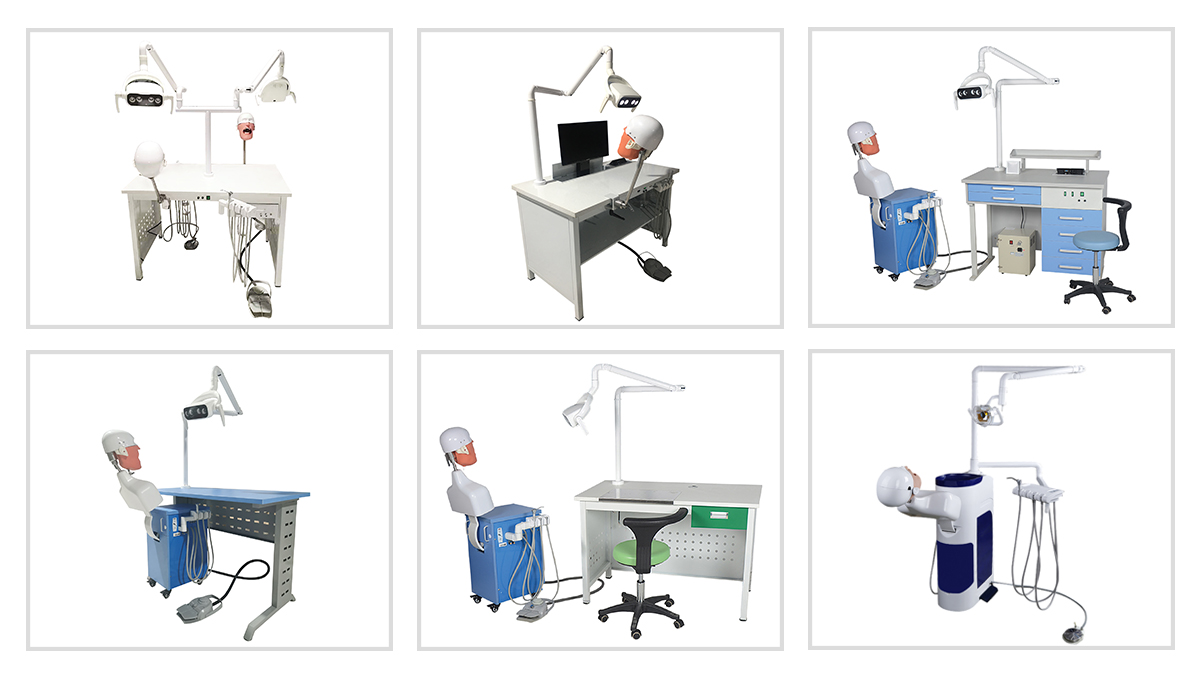
Dental schools and training centres use the same benches in rows. The training room is where students work through prosthodontics, orthodontics, oral technology and restorative exercises, so every station has to give the same working height, the same light and the same suction — otherwise a class of twenty is working on twenty different benches.
For these rooms we normally recommend one bench length across the whole row and one dust configuration, so the room can be planned as a single installation. The three-technician bench is the usual choice for demonstration, because an instructor can stand at one end while three students work. The TT-3 is supplied with three dust collectors, three air guns, six five-hole socket points with three lidded power sockets, a 1.5 m light, and three stainless-steel working boards, and can be fitted with a 21.5-inch monitor arm for showing procedures.

TT-3 three-technician bench, with lidded power sockets and a monitor arm
Benches in a training room are connected end to end, which keeps the row continuous and stops students from working in the gap between two units. The same arrangement works in a commercial laboratory where several technicians share one wall.
Yes. Dental lab workstation, dental laboratory workstation, dental lab workbench, dental lab table and technician bench all describe the same equipment, and UMG model names use both words — the JT-56 is sold as a dental lab workbench while the TT-3 is sold as a dental lab workstation. The model number is the reliable reference when comparing the two.
1.0–1.2 m is enough for a handpiece, a micromotor and the instruments in use. Step up to 1.4 m (the JT-54) if the station also holds a model trimmer or a second working area. Two technicians need 1.6 m or more, and the three-technician bench measures 2.0 m.
Yes. Every bench can be ordered either with a built-in collector or prepared for connection to a central dust collection system. The choice changes how the rear panel is prepared, so it has to be made before the order is placed rather than after the benches arrive.
Fireproof board is the standard and suits most finishing work. Stainless steel and granite are chosen where plaster, monomer and steam are in constant use. Artificial marble is fitted to the TT-3 and to benches where the surface is on show. Oak is available where a warmer surface is wanted.
The benches, the dust extraction and the micromotors come from the same range, and the benches can be joined into continuous runs. Send the room plan with the number of students and we will confirm the bench lengths, the number of dust units and the socket layout for the whole room.
Send the number of technicians, the room dimensions and the dust route you plan to use, and we will confirm the bench length, the model and the table top. Request a quotation from our dental laboratory team.