
Over 50% of dental assistants report chronic neck or shoulder discomfort — and in many cases, the chair they sit in for eight hours a day is a major contributing factor. Yet when it comes time to purchase a new dental assistant chair, most clinics focus almost entirely on price and forget to ask the questions that actually matter: Is the seat height range tall enough? Does it have a proper foot ring? What kind of arm support does it provide?
This buying guide breaks down every feature you need to evaluate before purchasing a dental assistant chair — from the critical (seat height, foot ring) to the often-overlooked (upholstery material, caster type). Whether you are equipping a new practice, replacing aging chairs, or a dental assistant advocating for better seating, this guide gives you the knowledge to choose with confidence.
Before evaluating features, it helps to understand what category of seating you actually need. The terms "dental assistant chair," "dental stool," and "doctor's stool" are often used interchangeably in catalogs — but they describe meaningfully different products.
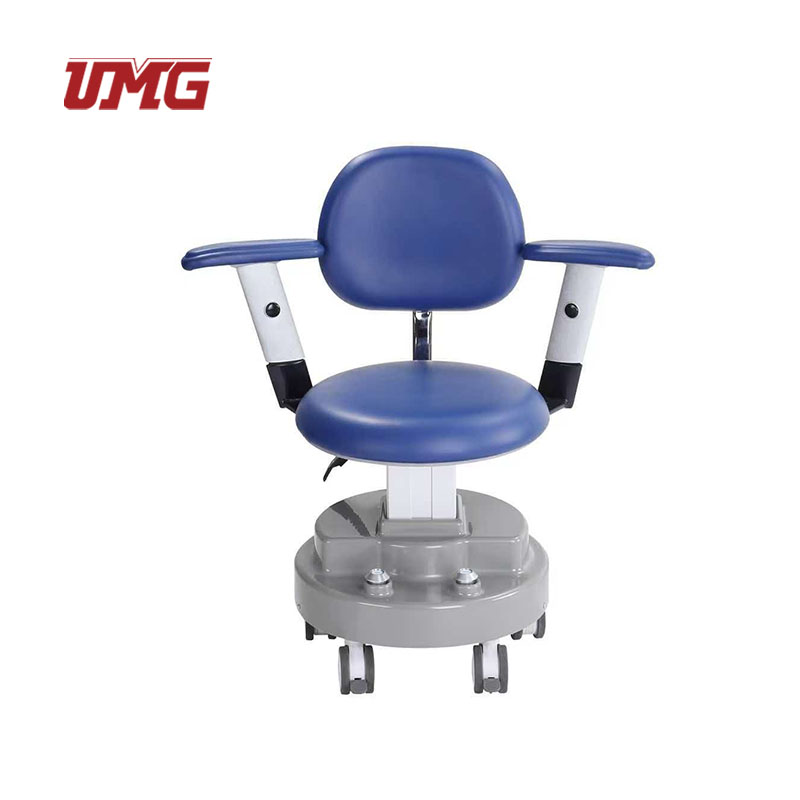
A dental assistant chair is purpose-built for chairside assisting. It sits significantly higher than a doctor's stool, typically ranging from 20 to 30+ inches from the floor, because the assistant needs to position themselves above and slightly behind the patient to pass instruments and maintain clear sightlines into the oral cavity. It also commonly features a foot ring, armrest or torso bar, and a contoured backrest.
A doctor's stool, by contrast, is designed for the operator working at the patient's head. It sits lower — typically 16 to 21 inches — and rarely includes a foot ring or arm support. Using a doctor's stool as an assistant's chair is one of the most common and damaging setup mistakes in dental ergonomics.
| Assistant Chair | Doctor's Stool | General-Use Stool | |
|---|---|---|---|
| Seat Height | 20"–30"+ (tall range) | 16"–21" (lower range) | 18"–24" (mid range) |
| Foot Ring | Standard / required | Rare | Rarely included |
| Armrest / Torso Bar | Often included | Rarely included | Not included |
| Lumbar Support | Contoured backrest | Minimal or none | Basic or none |
| Primary Use | Chairside assisting | Clinical procedures | Admin / reception |
Rule of thumb: The assistant's eye level should be approximately 4–6 inches (10–15 cm) above the operator's eye level. If your current chair cannot reach that height, it is the wrong product.
If there is one specification you evaluate above all others, it is the seat height range. This single number determines whether the chair can actually support proper clinical positioning — and no amount of lumbar support or premium upholstery can compensate for a chair that simply does not go high enough.
Start with the doctor's chair. Measure the seat height at which the operator will be working. Your assistant chair needs to reach a seat height approximately 4 to 6 inches above that measurement. Most operator stools sit between 17 and 21 inches; that means an assistant chair should be capable of reaching 23 to 27+ inches at minimum.
Pay close attention to the upper end of the height range, not just the minimum. Many budget chairs advertise a height range starting at 18 inches but max out at 23 or 24 inches — insufficient for taller assistants or high-mounted operator chairs.
Most dental assistant chairs use a pneumatic gas cylinder for height adjustment. Manufacturers typically offer two or three cylinder options:
Standard cylinder: approximately 20–25 inches. Suitable for most average-height setups.
Tall cylinder: approximately 22–30 inches. Recommended for taller assistants or elevated patient chairs.
Low cylinder: approximately 17–22 inches. Rarely needed for assistant seating — verify carefully before ordering.
When ordering, confirm which cylinder is included as standard and whether upgrading is possible.
Pro tip: If you are unsure, order the tall cylinder. A chair that goes slightly higher than you need is always adjustable downward. A chair that maxes out below your working height is a permanent problem.
The foot ring is perhaps the most underappreciated component of a dental assistant chair. At elevated seat heights, the assistant's feet cannot rest flat on the floor, which creates significant pressure on the underside of the thighs and restricts blood circulation to the lower legs. A properly positioned foot ring eliminates this problem entirely.
This is a decision with a clear answer: always choose an adjustable foot ring. A fixed foot ring is calibrated for one seat height only. The moment you raise or lower the chair — to accommodate a different assistant, a different patient chair height, or a different procedure — the fixed ring becomes either too high or too low, defeating its purpose.
An adjustable foot ring moves independently of the seat, allowing the user to set it at the correct height regardless of where the seat is positioned. Look for a foot ring with at minimum a 5-inch adjustment range; ranges of 6 to 8 inches are better.
Foot rings are typically manufactured in chrome-plated steel or polished aluminum. Pay close attention to the locking mechanism: the ring should lock firmly at the desired height without creeping downward under sustained foot pressure. A diameter between 12 and 14 inches works well for most adults.
Watch out for: Some budget chairs list "foot ring included" but ship with a fixed-height ring welded at one position. Confirm adjustability before purchasing, especially on chairs priced under $250.
This is the feature category where dental assistant chairs differ most dramatically — and where most buyers spend the least time researching. The two primary options are the torso bar (also called a body support bar or abdominal rest) and the armrest.
The torso bar is the traditional design. It is a padded horizontal bar positioned at abdomen height, against which the assistant leans their torso during procedures. By distributing some of the assistant's weight forward onto the bar, it reduces muscular load on the lower back during sustained forward lean.
Torso bars work well for assistants who habitually lean forward to pass instruments or suction. However, they do nothing to address shoulder and neck fatigue — and for some users, sustained pressure against the abdomen becomes uncomfortable during longer procedures.
The armrest is increasingly considered the more ergonomically sophisticated option. By supporting the weight of the forearms directly, a properly positioned armrest reduces muscular load on the neck, upper trapezius, and shoulder girdle — the areas where dental assistants most commonly develop chronic pain.
Not all armrests are equal. The minimum requirement for a clinical-grade armrest is three-axis adjustability:
Height adjustment: the armrest surface must move up and down to match elbow height.
Width adjustment: left and right positioning must accommodate different shoulder widths.
Rotation: the armrest surface should pivot or swivel to match the natural angle of the forearm during chairside work.
Budget chairs often include armrests that adjust only in height. These provide marginal benefit compared to a well-designed three-axis system. If arm support is a clinical priority, allocate budget here accordingly.
For assistants without existing shoulder or neck issues working shorter shifts, a torso bar is a practical and cost-effective choice. For assistants logging six or more hours of chairside time daily, or those with any history of upper-body musculoskeletal complaints, a three-axis armrest is the more defensible investment.
The word "ergonomic" appears on nearly every dental assistant chair sold today. It has become functionally meaningless as a marketing term. Here is what to look for instead.
A quality backrest actively supports the lumbar curve. The human lumbar spine has a natural inward curve (lordosis), and seating that flattens this curve over the course of a shift accelerates disc compression and muscle fatigue. Look for a backrest with a pronounced convex lumbar zone, ideally with some degree of vertical position adjustability so it aligns with the L2–L4 region regardless of the assistant's height.
Equally important — and frequently ignored — is the seat angle. A seat that slopes slightly forward (anterior tilt) keeps the pelvis in a neutral position and allows the lumbar curve to maintain itself naturally. A seat that slopes backward forces a posterior pelvic tilt, which flattens the lumbar curve and transfers load to the spinal discs.
Many mid-range and premium chairs include a seat tilt adjustment, sometimes called a "waterfall seat" or "forward tilt" mechanism. If backrest adjustment and seat tilt work together, the chair becomes genuinely ergonomic — not just labeled as such.
Three materials dominate the market:
PU leather: Most common in budget and mid-range chairs. Easy to wipe down, acceptable infection control. Tends to crack at seams after 2–4 years of heavy use. Avoid formulations that degrade with alcohol-based cleaners.
Microfiber upholstery: Softer, better moisture management, more comfortable for long sessions. Requires non-ionic detergent cleaning — check manufacturer specifications.
Clinical vinyl: Standard in premium brands. Most durable, chemical-resistant, and infection-control-compliant. Typically available in a wide range of colors.
Dual-wheel casters provide better stability and smoother rolling than single-wheel designs. Polyurethane wheels are quieter on tile and harder floors than rubber wheels. Always verify the caster load rating against expected user weight — budget chairs sometimes have casters rated below the chair's advertised capacity.
For base construction, aluminum is lighter and corrosion-resistant; steel is slightly more rigid under dynamic load. For chairs moved frequently between operatories, aluminum is preferable.
Infection control note: The seam between the seat cushion and backrest is a common accumulation point for biological material. Look for chairs with seamless or bonded seat-to-back transitions, or confirm the junction is fully sealed with the chosen upholstery.
Dental assistant chairs range from under $150 to over $1,500. Here is an honest assessment of what each tier delivers.
| Price Range | Best For | Key Features | Typical Brands |
|---|---|---|---|
| $100–$300 | Budget clinics, backup chairs | Basic height adjust, PU leather, simple foot ring | VEVOR, generic imports |
| $300–$600 | Solo practices, cost-conscious buyers | Adj. foot ring + armrests, wider seat height range, microfiber | Mid-tier imports, Brewer entry |
| $600–$1,200 | Multi-chair practices, ergonomic priority | Flex lumbar, 3-axis armrests, multi-cylinder options | ASI Dental, Belmont, DCI Edge |
| $1,200+ | Premium practices, long-term investment | Full customization, extended warranty, premium upholstery | A-dec, Crownseating, Midmark |
One important caution about budget chairs: low price often reflects lower-grade gas cylinders (which fail faster), thinner upholstery (which cracks sooner), and casters with lower load ratings. A $150 chair replaced every 18 months is more expensive — and ergonomically worse — than a $600 chair lasting seven or eight years.
Saddle chairs have gained significant traction in dental ergonomics over the past decade. Rather than positioning the hips at a 90-degree angle, a saddle seat tilts the pelvis forward — mimicking a horseback riding posture — which allows the lumbar spine to maintain its natural curve without relying on a backrest.
For dental assistants with existing lower back pain, or those who have tried every traditional chair without relief, a saddle option is worth serious evaluation. The adaptation period is typically one to two weeks.
| Traditional Assistant Chair | Saddle-Style Chair | |
|---|---|---|
| Posture | Hips at ~90°, lumbar relies on backrest | Pelvis tilted forward, spine self-corrects |
| Back Support | Relies on backrest quality | Natural lumbar curve — less backrest dependency |
| Adjustment Period | Immediate | 1–2 weeks to adapt |
| Foot Ring | Usually included | Often not needed (feet rest on floor) |
| Cost | $100–$1,200+ | $200–$800 typical |
| Best For | Most clinic setups, all height ranges | Assistants with lower back history |
A dental assistant chair is purpose-built for chairside assisting and features a taller seat height range (typically 20–30+ inches), a foot ring, and often an armrest or torso bar. A dental stool is designed for the operating clinician, sits lower (16–21 inches), and is not a suitable substitute for a proper assistant chair.
The assistant's seat height should position their eye level approximately 4 to 6 inches above the operator's eye level. In practice, measure the doctor's chair height and add 10 to 15 cm. The assistant's feet should rest comfortably on the foot ring without the thighs pressing upward against the seat edge.
Yes — for any seat height above approximately 18 inches, a foot ring is essential. Without it, the back of the thighs press against the seat edge, restricting blood flow and accelerating fatigue. Always choose an adjustable foot ring over a fixed design.
A torso bar (also called an abdominal bar or body support bar) is a padded horizontal support positioned at approximately abdomen height. The assistant leans their torso against it during chairside work, reducing lower back muscular load during forward-lean postures. It is an alternative to a full armrest system.
Most standard dental assistant chairs are rated between 250 and 300 pounds. If the chair will be used by assistants approaching that limit, look for heavy-duty models rated at 350 pounds or above — and verify the casters carry a matching rating, as they are sometimes lower than the chair's advertised limit.
Cleaning protocol depends on the upholstery material. PU leather and clinical vinyl tolerate EPA-registered disinfectant wipes and quaternary ammonium cleaners — avoid bleach or alcohol-heavy formulations on PU leather, as they accelerate cracking. Microfiber should be cleaned with a non-ionic detergent solution. Always check the manufacturer's specifications; some warranties are voided by incompatible cleaning agents.
A dental assistant chair is not a commodity purchase — it is a clinical tool that directly affects the health, comfort, and performance of the people who use it for thousands of hours over its lifespan. The features that matter most are not complicated: a seat height range that reaches high enough, an adjustable foot ring, a backrest that genuinely supports the lumbar curve, and upper-body support suited to the assistant's working style.
For most practices purchasing their first quality chair, prioritize seat height range and foot ring adjustability above all else, then allocate remaining budget toward arm support and backrest quality. A chair that gets the fundamentals right will outperform a chair with premium branding but poor ergonomic basics every time.